
Jaden Industries Automation Ratios for Compact Factories
How to measure Jaden Industries automation ratios without published data: cycle time, input demand, belt throughput and a saturation test.
Jaden Industries does not publish a ratio table, and anyone who claims to have a complete one on day two is either datamining or guessing. What the game does give you is enough information to measure your own ratios: a recipe card, a machine cycle, and a belt that moves a countable number of items. The official press kit even shows one card with the input rates filled in, which makes a real worked example possible.
This guide starts with that confirmed card, then teaches the measurement method for everything else. It also keeps a clearly labelled illustrative example so the arithmetic is easy to follow without mixing made-up numbers into the game data.
The crafting chain guide→ shows which products feed which, and the budget and medals guide→ explains why a faster line is not always a better score.
Store facts were checked against the Steam and Nintendo listings on November 25, 2026. Systems that are not publicly confirmed are labelled as unconfirmed. Official source: Jaden Industries on Steam ↗
The only formula you need

Throughput is items per minute. For a machine with cycle time T seconds and output quantity Q per cycle:
output per minute = Q × (60 ÷ T)
If a downstream machine needs N items per cycle and completes a cycle every S seconds, its demand is:
demand per minute = N × (60 ÷ S)
Match the two numbers and the line is balanced. If supply is higher, the downstream machine is the bottleneck and the upstream buffer fills. If supply is lower, the downstream machine starves.
Confirmed example: Philosopher Blend
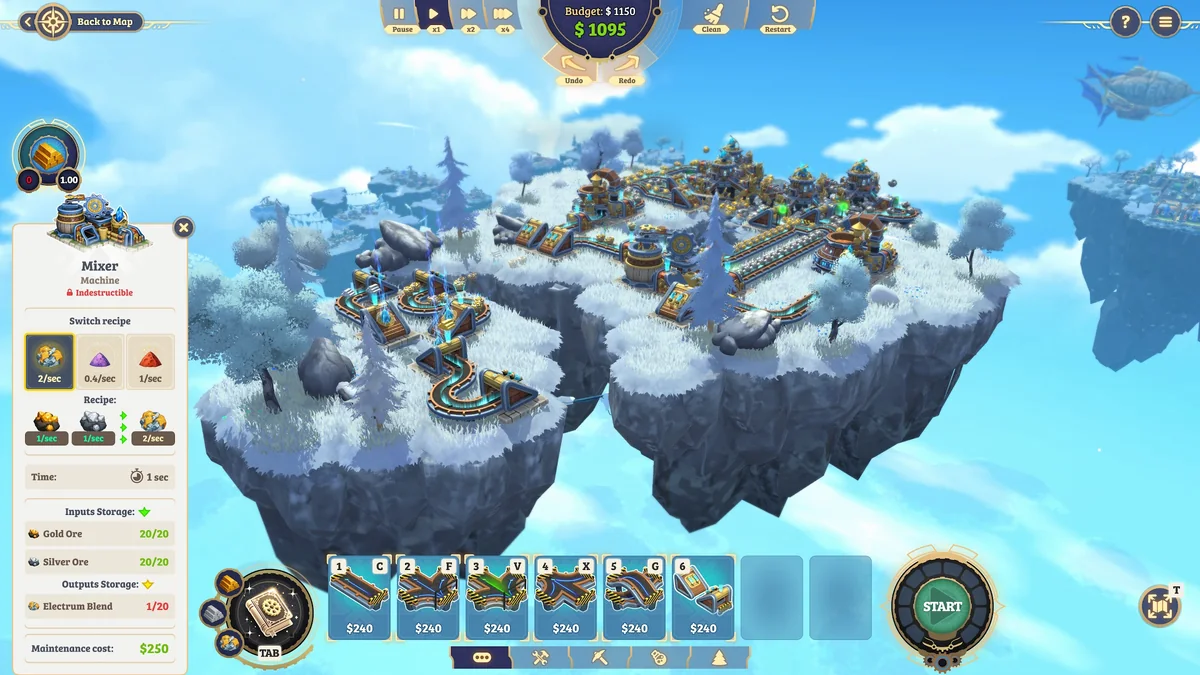
The official Crafting Recipes screenshot shows a Mixer making Philosopher Blend from 2 Salt + 2 Electrum Blend + 3 Mercury on a 1-second cycle. The card labels the input rates at 2/sec, 2/sec and 3/sec. Converted to minutes:
| Input | Per second | Per minute |
|---|---|---|
| Salt | 2 | 120 |
| Electrum Blend | 2 | 120 |
| Mercury | 3 | 180 |
Those are the feed rates for one continuously running Mixer. If your Salt line delivers only 90 per minute, the Mixer runs at three-quarters speed and the Philosopher Blend output slows with it. The fix is more Salt supply or fewer simultaneous Mixers, not a faster downstream belt.
The card shows input demand, not a guaranteed output rate. Read the output side before you promise a product-per-minute figure, and measure the machine if the card leaves the output blank. The recipes guide→ records the card itself.
Illustrative example (not game data)
Suppose a machine produces 2 items every 6 seconds. Its output is 2 × (60 ÷ 6) = 20 items per minute. If the next machine needs 1 item every 2 seconds, its demand is 1 × (60 ÷ 2) = 30 items per minute. The line is short by 10 items per minute, and you need a second upstream machine or a faster recipe.
These numbers are made up to show the arithmetic. They are not Jaden Industries values.
How to measure cycle time in-game
- Empty the machine's output buffer or disconnect the downstream belt.
- Start a stopwatch when the first item appears.
- Count ten cycles, not one. Ten cycles average out animation jitter.
- Divide the total seconds by ten to get T.
- Note the output quantity Q from the recipe card.
If the card already shows a cycle time, use it and skip the stopwatch. If it shows a range, measure anyway; the displayed range may be an estimate.
How to measure belt throughput
Belt speed is the other half of the ratio. To measure it:
- Build a straight belt of known length, with no machines attached.
- Put a full buffer of items at the input.
- Count how many items pass a fixed point in 30 seconds.
- Multiply by two to get items per minute.
Do this once per belt tier. The number becomes a constant you can reuse on every island. Write it down; the game will not show it anywhere.
The saturation test
Math tells you what should happen. The saturation test tells you what is happening.
- Upstream buffer full, downstream idle: the downstream machine is too slow or blocked. Add a parallel machine or reduce the recipe demand.
- Upstream buffer empty, downstream waiting: the upstream chain cannot keep up. Add an extractor or upgrade the belt.
- Both buffers moving steadily: the line is balanced. Leave it alone.
- Both buffers full: the output is blocked. Check the consumer or the next belt.
Run the test for 60 seconds after every layout change. A line that looks balanced for ten seconds can starve on the eleventh.
Ratios by chain stage
The confirmed product tree has four stages: raw dust, refined products, complex products, and science. Each stage has a different ratio problem.
| Stage | What to balance | Common mistake |
|---|---|---|
| Raw dust | Extractor output vs first processing demand | Building one extractor for a two-machine chain |
| Refined products | Mixer inputs vs processing output | Assuming equal input quantities |
| Complex products | Multiple inputs arriving at the same rate | Letting one input fill the hub |
| Science | Production vs research spending | Overbuilding science before the product line works |
For the chain structure, see the crafting chains guide→. For the physical arrangement, see island layouts→.
Why compact islands change the math
On a large factory game, you can solve a ratio problem by adding machines. On a Jaden Industries island, space and budget are fixed. A second machine may not fit, and a longer belt may blow the budget. That pushes you toward three solutions:
- Slow the demand. If a recipe allows a slower cycle, a smaller supply can still satisfy it.
- Buffer the difference. A small buffer absorbs a burst, but it does not fix a persistent deficit.
- Reroute the chain. Sometimes the cheapest fix is a shorter belt, not another machine.
The budget system is what makes ratios matter. An oversized line costs money and scores worse than a balanced one. The budget and medals guide→ explains how the score responds.
When to stop optimizing
A perfectly balanced line is not the goal. The goal is a layout that finishes the island under budget. If a line runs at 90% efficiency and the island scores a medal, the last 10% is not worth a rebuild unless you are chasing a leaderboard or an achievement.
The achievements that do reward optimization are the 100% island completions and the medal collection. The achievement guide→ lists the thresholds and the current global completion rates.
FAQ
Does Jaden Industries publish machine ratios?
Not as a complete table. One official recipe card, Philosopher Blend, shows its input rates directly. Every other ratio has to be read from the card or measured in-game. This guide shows how to derive your own.
What is the ratio formula?
Output per minute equals output quantity times 60 divided by cycle time in seconds. Demand uses the same formula with the downstream machine's numbers.
How do I know if a line is balanced?
Run the saturation test: watch the upstream and downstream buffers for 60 seconds. A balanced line keeps both moving without either staying full or empty.
Are the Philosopher Blend numbers real?
Yes. The 2 Salt, 2 Electrum Blend and 3 Mercury inputs, the 1-second cycle and the 2/sec, 2/sec and 3/sec rates all come from the official Crafting Recipes screenshot. The 2-items-per-6-seconds example later on is illustrative; do not mix the two.